


Divya
MBA from IIM Lucknow. I have led machine-learning teams at ANZ Institutional Bank and Zolvit, and worked across fintech firms. I am drawn to the daily trading-operation problems that look small on paper but become expensive in live execution.
By the time execution risk shows up in PnL , the desk is already late.
We use mathematics, machine learning, and market structure to detect it earlier.
Why market makers should care about the few seconds that damage the book.
The hidden execution failure modes that decide whether a live strategy survives.
Why market-making risk is better understood through regimes than isolated signals.
Why high R² can still mean zero trading edge in financial time-series machine learning.
Why path-dependence tests should be used as diagnostics, not forward-selection engines.
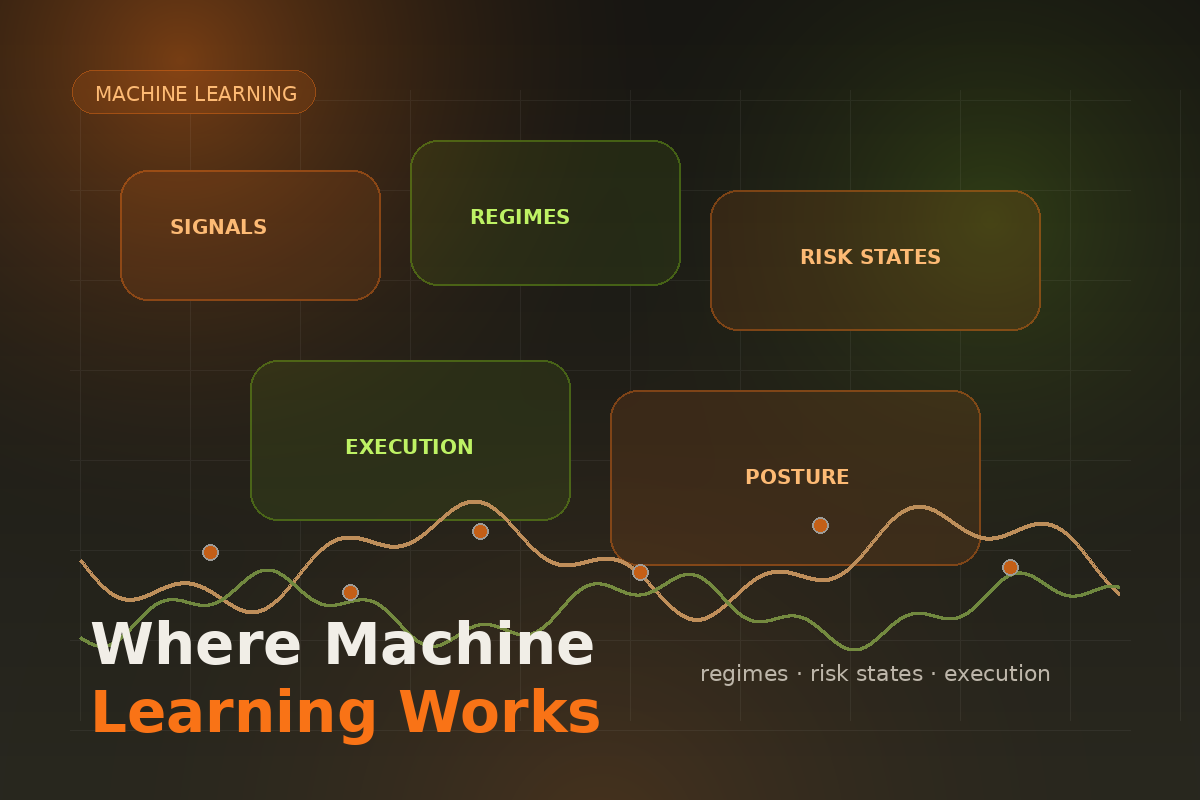
Why machine learning is strongest when it detects regimes, risk states, and execution conditions — not when it blindly predicts price.
We are not trying to sell generic AI dashboards. We like the unglamorous problems that decide live PnL: hedge timing, toxic fills, slippage, market-state shifts, and model validation.
MBA from IIM Lucknow. I have led machine-learning teams at ANZ Institutional Bank and Zolvit, and worked across fintech firms. I am drawn to the daily trading-operation problems that look small on paper but become expensive in live execution.
B.Tech from IIT. Suresh has handled product teams at Freshworks and Byju’s, built his first company at 21, and exited through acquisition. He enjoys hard quant, machine-learning, and execution-infrastructure problems where the details really matter.
In a 10-minute briefing, we can walk through how execution-layer ML overlays may apply to your quoting, hedging, volatility, slippage, or market-making workflow. The goal is simple: find where tail exposure is concentrating before it damages the book.