Options · Crypto Market Making · HFT Execution Risk

Execution-layer ML for options, market-making and HFT desks.

Alphashots.ai builds custom machine-learning overlays that sit outside the order path — helping desks identify short windows where quoting, replenishment, routing, or hedging behavior becomes unsafe.

Dynamic Delta Hedging Greeks Risk Vanna / Gamma / Charm Volatility Clusters Adverse Selection
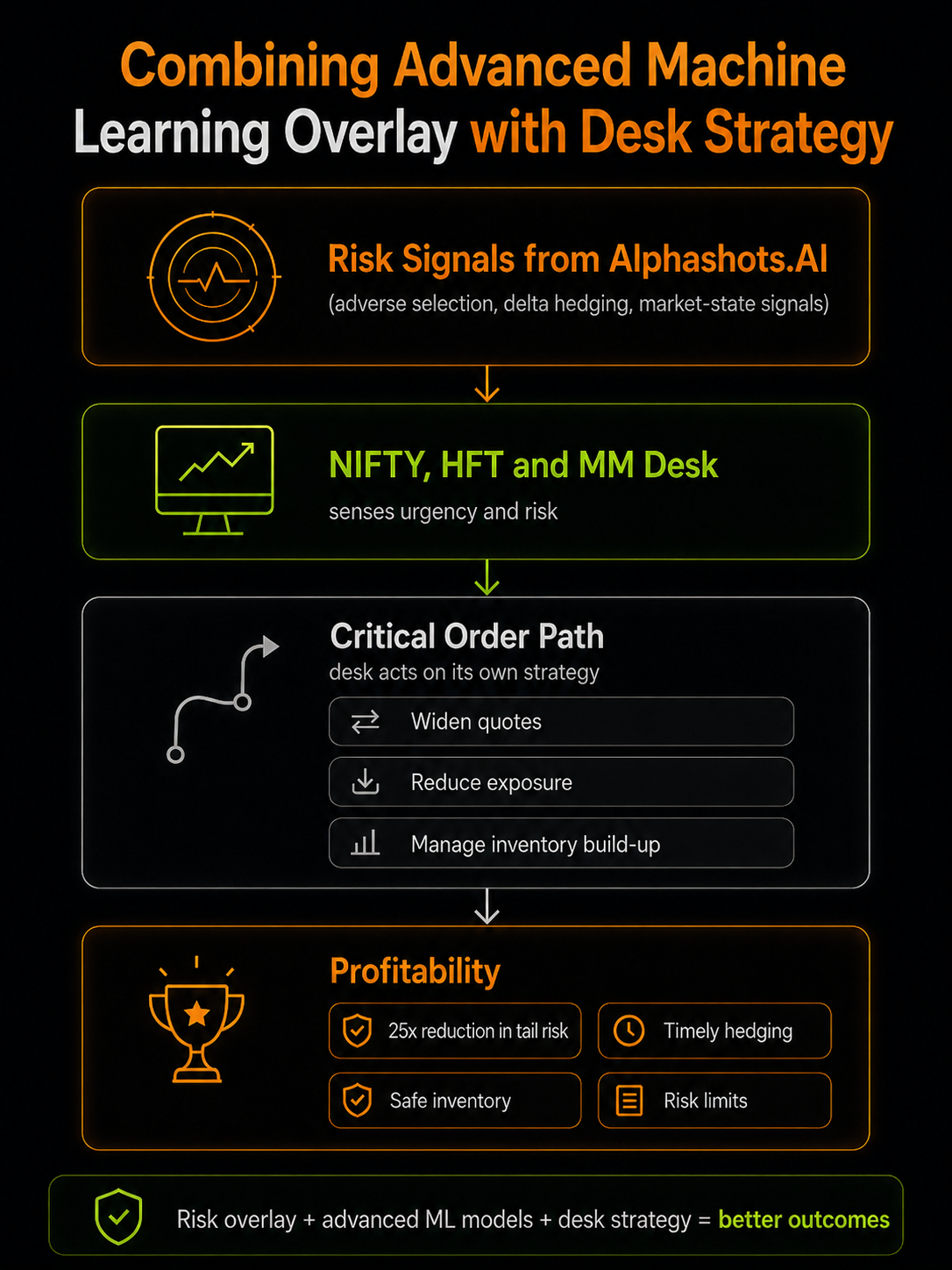
Combining advanced machine learning overlay with desk strategy: Alphashots.ai risk signals flow to NIFTY, HFT and market-making desks, then to critical order path actions and profitability outcomes.

The expensive seconds are not evenly distributed.

Execution risk often appears as a small number of concentrated windows: toxic fills, volatility jumps, unstable Greeks, stale hedges, and liquidity thinning. The desk does not need generic AI. It needs practical models that tell it when execution posture should change.

01

Adverse selection and toxic flow

In crypto, passive liquidity can be picked off within seconds when aggressive flow predicts continuation. NIFTY desks face the same execution problem when fills or hedges happen just before the market moves away.

02

Dynamic delta-hedging lag

NIFTY options desks face fast-changing delta, gamma, vanna, charm, and volatility exposure. ML overlays can monitor Greeks stress, detect hedge timing risk, and flag when normal hedge intervals are no longer safe.

03

Slippage and impact cost

Execution quality worsens when liquidity thins, spreads widen, or replenishment happens too aggressively after a poor fill. The cost is usually visible only after PnL has already absorbed it.

04

Volatility clusters and regime shifts

Static rules break when market state changes quickly. Volatility clusters, event windows, and flow imbalance require adaptive execution-risk controls.
An overlay outside the order path.

Alphashots.ai is designed as an execution-risk intelligence layer. It does not need to sit inside the latency-critical order path. The overlay consumes market, flow, volatility, and options-state data, then returns risk scores and action flags to support desk decisions.

Alphashots.ai overlay off-path · adds no latency Mirror feed market data Models Greeks, Adverse Selection Risk signals scores & flags Trading desk human-in-the-loop Latency-critical order path your fast path stays untouched Strategy algo / signals OMS / EMS order management Exchange venue / matching read-only mirror risk scores & flags desk acts never injects orders
Desk acts on its own systems Reduce size Slow replenishment Widen quotes Hedge earlier Pause passive liquidity Reroute Raise monitoring
read-only data in risk signals out never touches your orders
Important design principle: the overlay sits outside the order path. It is not a black-box auto-trader and does not require taking control of strategy, orders, or positions. It is a risk intelligence layer that can be integrated with existing execution and monitoring workflows.

Where executional ML can help Options, Market Making, and HFT desks.

The point is not to replace the trader or the strategy. The overlay gives the desk an external risk layer that flags when normal execution behavior is becoming expensive.

NIFTY OPTIONS

Hedging, Greeks stress, and volatility windows

For NIFTY and index-options books, the main pain is often not direction prediction. It is hedge timing and exposure control during fast state changes.

  • Dynamic delta-hedging alerts when delta changes faster than the desk’s hedge cadence.
  • Gamma, vanna, charm, and vega stress monitoring around expiry, opening moves, and volatility bursts.
  • Deep learning models for nonlinear Greeks states: IV shift, OI change, spot move, short-horizon flow, and hedge-risk combinations.
  • Volatility-cluster detection before execution quality visibly deteriorates.
CRYPTO MARKET MAKING

Toxic flow, inventory protection, and quote posture

Crypto market makers face short windows where passive liquidity gets picked off and the book is damaged before standard risk controls react.

  • Adverse-selection scoring when aggressive flow is followed by short-horizon price continuation.
  • Tail-risk gating to reduce quote size, slow replenishment, or widen within allowed bands only when risk concentrates.
  • Regime-aware liquidity monitoring across spread, depth, imbalance, trade intensity, and volatility state.
  • Post-trade diagnostics to separate normal inventory loss from avoidable toxic-fill exposure.
HFT DESKS

Execution quality, slippage, and live-risk monitoring

For HFT desks, the value is in detecting tiny execution-risk windows without interfering with the latency-critical order path.

  • Outside-order-path risk overlay for monitoring, alerts, and execution-state classification.
  • Slippage and impact-cost attribution by liquidity thinning, stale quotes, queue position, event windows, and timing delay.
  • Regime-shift detection when static thresholds stop behaving well.
  • Model validation and live monitoring to know when a signal is degrading before PnL absorbs the full cost.

Research-backed framework, not generic AI tooling.

Our SSRN working paper, Predicting Adverse Selection in High-Frequency Cryptocurrency Markets Using Gradient Boosting, studies whether the short windows that damage a market-making book can be identified before the loss happens.

The framework combines a toxicity classifier with a severity model to form TailScore. Instead of asking only whether a second is risky, TailScore asks a more useful desk-level question: how risky is this second, and how large could the tail move be if adverse selection occurs?

Data
31.08M
second-level observations
Method
LightGBM
classifier plus tail-severity model
Result
25.85×
CVaR99 efficiency at the 0.1% gate

Research notes from Alphashots.ai.

These notes explain the thinking behind our execution-risk framework: tail concentration, regime awareness, execution failures, and validation discipline.

Two builders who like solving messy trading problems.

We are not trying to sell generic AI dashboards. We like the unglamorous problems that decide live PnL: hedge timing, toxic fills, slippage, market-state shifts, and model validation.

D

Divya

Co-founder · Alphashots.ai

MBA from IIM Lucknow. I have led machine-learning teams at ANZ Institutional Bank and Zolvit, and worked across fintech firms. I am drawn to the daily trading-operation problems that look small on paper but become expensive in live execution.

S

Suresh

Co-founder · Alphashots.ai

B.Tech from IIT. Suresh has handled product teams at Freshworks and Byju’s, built his first company at 21, and exited through acquisition. He enjoys hard quant, machine-learning, and execution-infrastructure problems where the details really matter.

Want to test whether your desk has hidden execution-risk windows?

In a 10-minute briefing, we can walk through how execution-layer ML overlays may apply to your quoting, hedging, volatility, slippage, or market-making workflow. The goal is simple: find where tail exposure is concentrating before it damages the book.

divya@alphashots.ai · Alphashots.ai · Execution ML Intelligence